Published on February 19, 2026

Written by: Brandi Wharton

Finding a dentist has changed.
People no longer rely solely on word of mouth or drive-by signage. Instead, they search for terms like ‘dentist near me’, ‘emergency dentist Tauranga’, or ‘Papamoa dental clinic open today’. In those moments, Google, Maps, and increasingly AI-powered search tools decide which clinics get seen first.
To understand how well Tauranga area dental clinics are positioned in this search environment, we carried out a detailed review of 10 local practices, looking at both their websites and Google Business Profiles.
What we found wasn’t poor intent or low effort. It was a pattern of underused fundamentals that directly affect visibility, trust and bookings.
Table of contents:
- How we reviewed dental websites and local search presence
- What we found on dental clinic websites
- FAQ content is lacking
- Reviews are severely underutilised
- Booking journeys aren’t always obvious
- Mobile experience was mostly strong
- Image optimisation and alt text are largely overlooked
- Heading structure is often unclear or inconsistent
- Title tags and meta descriptions are not working hard enough
- Measurement is in place, insight not guaranteed
- Google Business Profile review areas
- What this research means for dental clinics
- High impact improvements we’d prioritise first
- Why Found is publishing this research
How we reviewed dental websites and local search presence
Each dental clinic was reviewed using the same criteria, focusing on how search engines, AI platforms, and real customers interpret their online presence.
For this research, we reviewed a sampling of dental practices across Tauranga, Mount Maunganui and Papamoa. Each clinic was assessed across two core areas:
- Website performance and usability
- Local search visibility
Each area was scored using a simple 0–3 scale. This was used to identify strengths, gaps, and patterns, not to rank or criticise individual clinics.

What we found on dental clinic websites
Most dental clinic websites looked professional. Clean layouts, calming colours, and modern design were common across the board.
However, visual appeal doesn’t always translate into usability or search clarity. Across the sites we reviewed, we consistently saw issues that made it harder for both people and search platforms to understand what the clinic offers, who it serves, and how to take the next step.
Common issues included:
- Headings that didn't clearly reference ‘dentist’ or ‘dental clinic’
- Service pages that weren’t easy to access from primary navigation
- Location targeting that could be much stronger
- Content above the fold missing relevant keywords and clear calls to action
For search engines, and more importantly for people, clarity matters more than a polished website.
FAQ content is lacking
One of the biggest missed opportunities across dental websites was FAQ content. While six out of ten had a dedicated FAQ page, the quality of that content varied widely.
Only a small number of clinics included:
- New patient FAQ
- Emergency dentistry questions
- Payment, insurance or WINZ information
- What to expect at a first appointment
This is a missed opportunity for several reasons:
- FAQ help patients feel informed and reassured
- They reduce friction before booking
- FAQ align with how people search and how AI platforms (Large Language Models such as Claude, ChatGPT) surface answers
Dental care is a trust-driven decision. When websites don’t proactively answer common questions, uncertainty creeps in. Which means, people often keep searching.
Reviews are severely underutilised
Most clinics had Google reviews, and many had strong overall ratings.
However:
- Reviews were rarely embedded on the website
- Testimonials were often outdated or hidden
- When reviews were included, they were usually static and only a few were used
Reviews are no longer just social proof. They are conversion drivers, AI trust markers, and part of the local ranking signals mix.
When reviews live only on Google, and aren’t reinforced on your own site, you’re missing an opportunity to build trust at the exact moment someone is deciding whether to book.

Booking process isn't always obvious
Another common pattern was uncertainty in the booking process.
While a few clinics handled this exceptionally well by using dedicated online booking systems with clear next steps, others created friction by blurring the line between enquiry and appointment booking.
We saw:
- ‘Book now’ buttons that led to a general contact form
- Booking links buried within navigation menus
- Emergency dentistry information difficult to find
- Different calls-to-action across service pages
While it’s completely acceptable for a clinic to require phone bookings, the process must be explicit. Patients should immediately understand whether they are expected to:
- Book online
- Request an appointment via a form
- Call the clinic directly
In a category where urgency and reassurance matter, clarity beats creativity. If someone hesitates about how to book, they often move on.
Mobile experience was mostly strong
This was a win for most of the websites we reviewed. Overall, the majority of dental websites were mobile-friendly.
Pages generally:
- Loaded well
- Displayed correctly on mobile screens
- Used readable text sizes
However, some mobile issues still appeared:
- Expanded menus that were difficult to tap
- Forms that felt clunky
- Phone numbers not clickable
- Important information pushed too far down the page
For local dental searches, which are heavily mobile-driven, these small issues can add up.
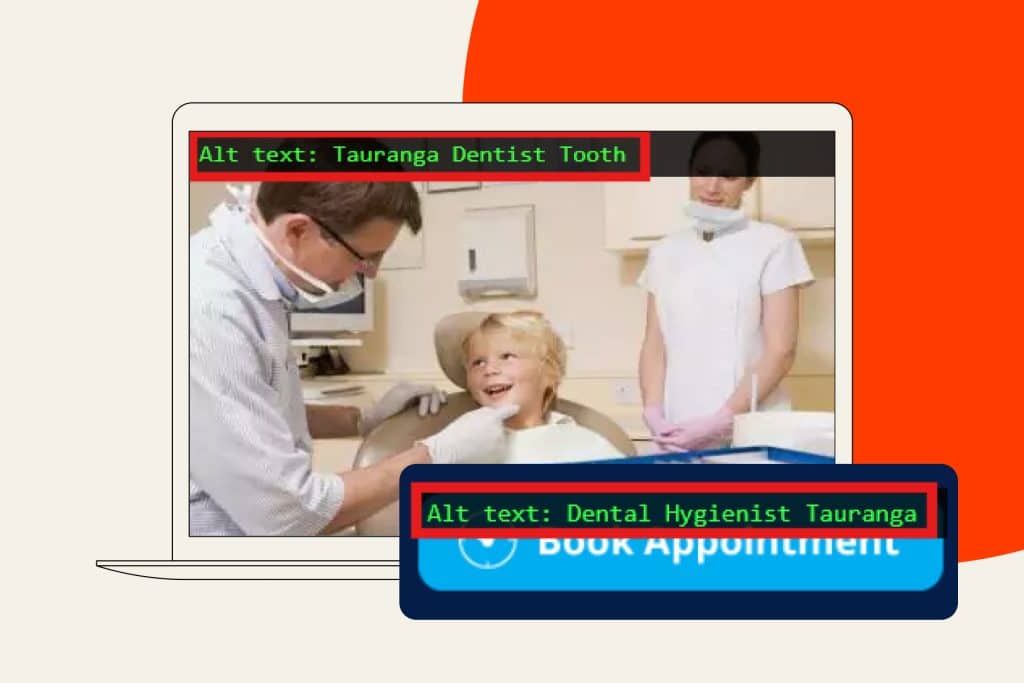
Image optimisation and alt text are largely overlooked
Across most of the dental clinic websites we reviewed, image alt text was either missing, auto-generated or inaccurate.
Examples included:
- File names used as alt text (e.g. IMG_2487.jpg)
- Empty alt attributes
- Keyword stuffing that didn’t reflect the image content
Alt text plays an important role in:
- Accessibility for screen readers
- Helping search engines understand images for image search
- Reinforcing topical relevance (e.g. dentist, dental services, location)
For dental clinics, where imagery often includes treatment rooms, staff, and patient environments, this is a missed opportunity to provide both context and trust signals.
Note: In the images above, the alt text is not describing the image or its functionality. Instead of ‘Tauranga Dentist Tooth’, a better option for the alt text would be: A dentist examines a child’s teeth during a dental exam at [name of dental clinic]. For the Book Appointment button, rather than simply using the keywords ‘Dental Hygienist Tauranga’, the function of the button should be described: Button linking to online appointment booking for [name of dental clinic].
Heading structure is often unclear or inconsistent
Another recurring issue was poor heading hierarchy.
We commonly saw:
- Multiple H1s used on a single page (or none at all)
- Headings styled visually but not structurally
- Service pages without clear subheadings
- Long blocks of text with no scannable structure
Headings help:
- Search engines understand page structure
- Users quickly find relevant information
- AI tools extract and summarise content accurately
- Screen readers navigate content for users with accessibility needs
Without a clear heading framework, even good content becomes harder to interpret and less effective.
Title tags and meta descriptions are not working hard enough
While most websites had title tags and meta descriptions in place, many were:
- Duplicated across pages
- Too generic (e.g. Home | Dental Clinic)
- Missing service or location context
- Not written with the aim of users clicking through to the site
Title tags and meta descriptions don’t just influence search rankings. They influence whether someone clicks through to your website at all.
For high-intent searches like dental services, these elements should clearly communicate:
- What the clinic offers
- Where it’s located
- Why someone should choose it
When these basics are overlooked, clinics lose potential clients before they even reach the website.

Measurement is in place, insight is not guaranteed
Unlike some other industries we’ve reviewed, all dental clinics in this study had Google Analytics (GA4) installed.
However, installation alone doesn’t guarantee insight. Analytics are only useful when they’re actively used to understand:
- Which services attract the most interest
- How people move through the site
- Where users abandon the booking journey
- Whether website traffic is turning into enquiries
Without regular review and interpretation, valuable data goes unused, and opportunities to improve new patient acquisition are missed.
Google Business Profile review areas
For each dental clinic’s Google Business Profile, we assessed:
- Profile completeness and accuracy
- Primary and secondary category selection
- Review volume and recency
- Whether reviews were responded to
- Photo quality and freshness
- Visibility in map-based searches
While every clinic had an established Google Business Profile, the level of optimisation and ongoing management varied significantly.
Google Business Profiles are working hard for most dental practices
For dental clinics, Google Business Profiles are often seen by searches before the website itself.
They impact:
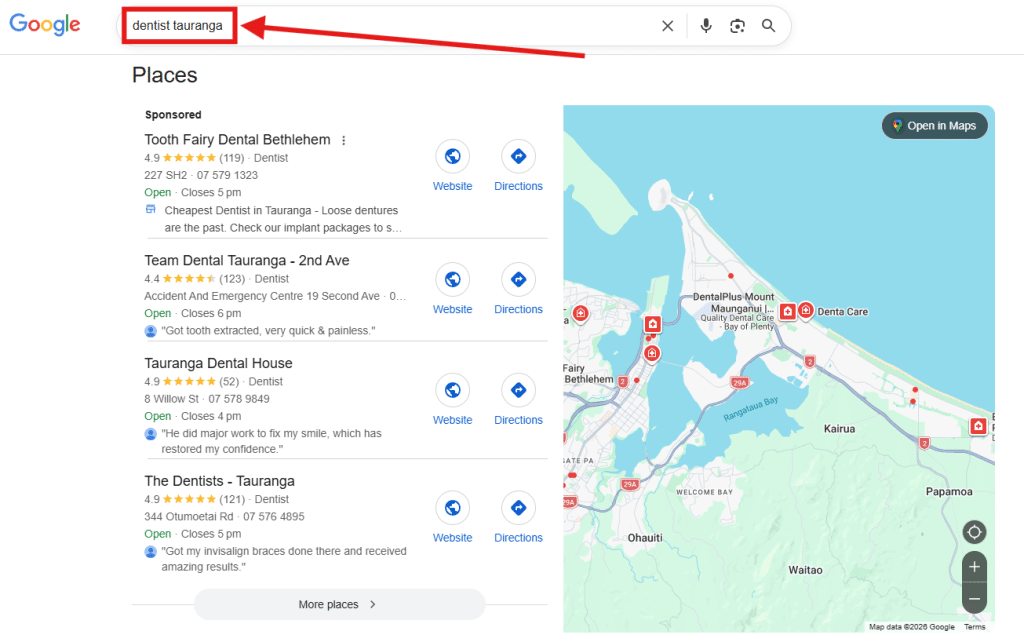
- Map Pack visibility
- Clicks for directions and calls
- First impression of the dental clinic
- Whether someone chooses your clinic over the one down the street
Key areas to pay attention to on your Google Business Profile
- Name, address and phone number accuracy
- Review recency and responses
- Category accuracy
- Photos and updates
- Engagement with the profile
Many clinics had solid foundations, but few were using their profiles to their full potential.
Reviews are often underused
Reviews are one of the strongest trust signals in healthcare. This can be particularly true for dental clinics where anxiety and reassurance play a major role in decision making.
While most clinics had a decent number of reviews:
- Responses were inconsistent or missing
- Review activity wasn’t always recent
- Reviews weren’t integrated into website content
Responding to reviews doesn’t just build goodwill with patients. It sends strong signals to customers that the business is active, credible and professional, and engaged with their patients.
Even brief, genuine responses can significantly improve perception and trust, and influence whether someone chooses your clinic over another.
Photos and posts are underutilised
Photos play a critical role in how businesses are perceived online, and dental practices are no exception.
We found that:
- A number of profiles relied heavily on user-uploaded images
- Staff, clinic interiors, and treatment rooms were underrepresented
- Photos were often outdated or inconsistent in quality
High-quality, regularly updated photos help:
- Build familiarity and trust
- Improve engagement in Maps results
- Influence click-through decisions
Similarly, Google Posts were rarely used, despite being an effective way to:
- Highlight a deal
- Promote availability
- Share clinic updates
For clinics competing in local search, these features represent low-effort, high-impact opportunities.
What this research means for dental clinics
The takeaway isn’t that Tauranga dental clinics are doing things wrong.
It’s that many are underperforming simply because they’re harder to interpret than they need to be, for both people and platforms.
Search visibility today depends on:
- Clear structure
- Readable, helpful content
- Strong technical foundations
- Consistent trust signals
- Active local engagement
When these elements work together, dental clinics are easier to find, easier to trust, and more likely to be chosen.
AI search insights
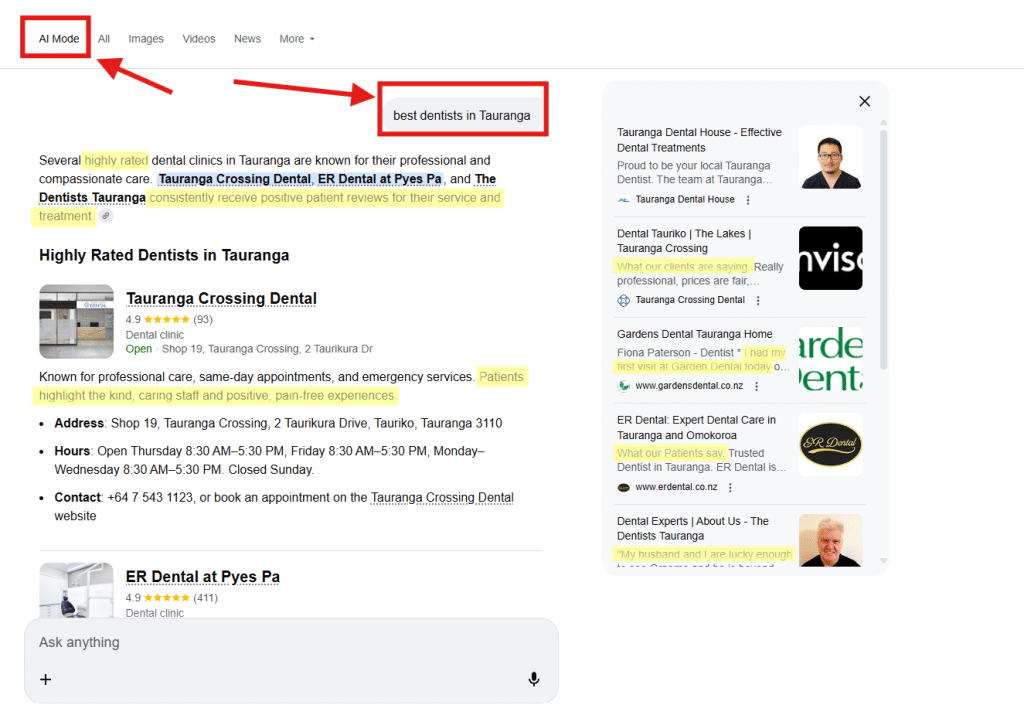
When testing AI-powered search queries like ‘best dentist Tauranga’, only a small subset of clinics were consistently referenced.
The most commonly cited sources were:
- Google reviews
- Customer sentiment
- Clearly structured clinic websites
You’ll note in the screenshot below that all the AI recommendations leaned heavily on customer ratings and reviews with specific references to how clients respond to their experience with individual clinics.
High impact improvements we’d prioritise first
Based on what we reviewed, these changes would likely deliver the biggest impact:
- Clarify page titles and headings with dentist + location
- Add a simple, patient-focused FAQ section
- Feature Google reviews directly on key pages
- Make booking actions immediate and obvious
- Actively respond to recent reviews
- Improve GBP categories, photos, and updates
None of these require a website rebuild. However, together, they dramatically improve visibility and conversions.
Why Found is publishing this research
This dental clinic review forms part of a broader research project where we analyse how Tauranga businesses are represented online—across websites, local search visibility, and Google Business Profiles.
Rather than highlighting faults, the purpose is to identify practical, achievable improvements that help businesses be more visible, trustworthy and competitive in their local markets.
We’ll continue publishing similar research across other local industries.
If you’d like to understand how your dental clinic is performing—or want support improving your local SEO, website clarity, or Google Business Profile—this is exactly the type of work our search specialists do at Found.
Related posts
Learn more about a range of digital marketing topics by diving into our other articles.
When Someone Searches for a Plumber in Tauranga, Who Actually Shows Up Online?
How well are Tauranga plumbing businesses showing up in local search results? We reviewed 10 sites and Google Business Profiles to see what opportunities are being missed.Read more

How Tauranga Cafes are Showing Up Online (And Where Local SEO for Cafes Is Falling Short)
We analysed 10 cafes across Tauranga to see how well they’re showing up online. The results may surprise you—some of them certainly surprised us.Read more

Frustrated to Found: Unlock Website Growth with an SEO Audit
Frustrated by low traffic or slow results? An SEO audit uncovers what’s slowing you down and how to improve performance.Read more

Free SEO audits are free for a reason – here is why you should avoid them
Take a minute and save yourself the confusion that free audits bring.Read more

5 Signs Your Website is Costing You Business (and How to Fix It)
Your website is often your first impression. If it’s slow, confusing, or outdated, it could be costing you business. Here are five signs you need a refresh.Read more

Online Reviews Help Tauranga Businesses Stand Out in Local Search
Reviews boost trust, improve local rankings, and help local businesses get discovered. Learn how to use reviews to strengthen your visibility and attract more customers.Read more

Feeling Overwhelmed by Google Ads? Take Back Control
Struggling to make Google Ads work for your business? You’re not alone. With the right approach, you can take back control, save time, and see real results.Read more

Technical SEO Audits: Uncover Hidden Issues Holding Your Website Back
Find out how a technical SEO audit can reveal hidden issues that stop your website from ranking well. Plus, what you can do to fix them.Read more
Want to be found? Send us an enquiry
Get expert insight into what’s working, what’s not, and the next steps to strengthen your digital strategy.